“Without proper logs, a breach investigation becomes guesswork.” – SANS Institute Incident Response Guidance
When a cyber incident occurs, one of the first questions investigators ask is “Do we have the logs”?
Logs are the backbone of security visibility. They show us how attackers entered systems, what actions they performed and how long they remained undetected.
But many organisations face a serious issue during investigations: the logs they need are no longer available.
This problem usually happens because of weak log retention policies, fragmented logging infrastructure or compliance requirements that were never properly implemented.
As regulations such as the Information Technology Act, 2000, the Digital Personal Data Protection Act, 2023 and directives from CERT-In increasingly mandate log retention and monitoring, companies must adopt structured strategies for log management.
This is where log retention and compliance best practices using CrowdStrike NG-SIEM become very important. Security teams can maintain compliance by using these best practices.
Why log retention matters for modern security operations
Logs are more than technical tools. They are key proof in cybersecurity investigations and audits.
Security teams depend on logs to understand:
- How attackers gained access
- Which systems were affected
- If sensitive data was exposed
- How long malicious activity persisted
Without sufficient retention policies, organisations lose the ability to reconstruct attack timelines. Regulatory frameworks also need organisations to keep logs for a certain amount of time. These requirements depend on the industry but mostly range from several months to multiple years.
Implementing log retention and compliance best practices using CrowdStrike NG-SIEM helps companies maintain long-term log visibility while keeping storage and operational costs manageable.
Common compliance requirements for log retention
In India, several regulatory bodies require organisations to maintain detailed logs for cybersecurity monitoring, forensic investigations and regulatory audits. Some of the most important regulations include:
RBI Cyber Security Framework
The Reserve Bank of India requires banks and financial institutions to maintain detailed system logs. They must be preserved for forensic analysis and continuous monitoring of suspicious activities across banking systems.
SEBI Cybersecurity and Cyber Resilience Framework (CSCRF)
SEBI requires stock exchanges, brokers etc. to implement centralized logging and monitoring mechanisms. Logs must be retained to support incident investigations and regulatory audits, particularly for trading systems and financial transactions.
CERT-In Directions (2022)
CERT-In mandates organisations to retain ICT system logs for a minimum of 180 days within Indian jurisdiction. These logs must be readily accessible for security incident analysis when requested by authorities.
IRDAI Cybersecurity Guidelines
Insurance sector organisations must maintain detailed audit trails and logs to detect and investigate cybersecurity incidents that affect policyholder data and financial systems.
Meeting these demands require a logging architecture that supports scalable storage, quick retrieval and centralized analysis.
What is CrowdStrike NG-SIEM and how it helps with compliance
Think of CrowdStrike NG-SIEM as a central control room for your security logs.
Every system in your organisation – endpoints, cloud platforms, applications, identity systems – generates logs. These logs contain valuable clues about suspicious activity, security incidents and compliance events.
The challenge is managing them properly.
Traditional SIEM platforms need complex infrastructure, constant tuning and a lot more maintenance just to keep log collection running. As data volumes grow, managing storage and performance becomes even more difficult.
CrowdStrike NG-SIEM simplifies this process.
It is built on the CrowdStrike Falcon platform and allows organisations to consume and analyse logs from multiple sources through a single cloud-native platform. Security teams can search logs quickly, detect suspicious behaviour and retain data for audit requirements.
In practice, this means organisations can maintain strong log retention policies while improving threat detection and reducing the operational burden of managing traditional SIEM infrastructure.
Key log retention best practices using CrowdStrike NG-SIEM
Effective log management requires structured processes rather than simple storage policies. Security teams implementing log retention and compliance best practices using CrowdStrike NG-SIEM typically follow several important steps.
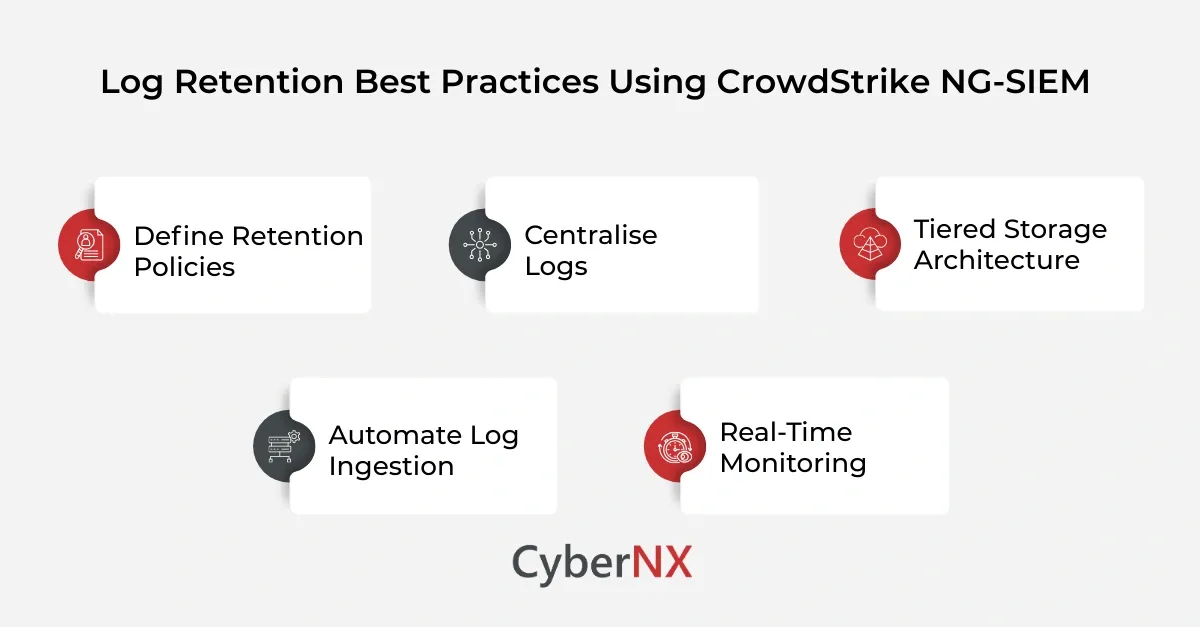
1. Define retention policies aligned with regulatory requirements/Define retention policies
Every organisation should establish clear log retention timelines based on regulatory obligations and operational needs.
For example:
- Security logs retained for 12–24 months
- Authentication logs retained for investigation support
- Compliance logs stored according to regulatory mandates
Clear policies make sure logs remain available during audits and investigations.
2. Centralise logs from multiple security sources/Centralise logs
Modern systems generate logs across many systems like endpoints, identity platforms, cloud workloads and SaaS applications. Centralising logs through NG-SIEM helps security teams:
- correlate security events
- detect suspicious patterns
- investigate incidents faster
Without centralized logging, valuable security insights remain fragmented.
3. Implement tiered storage for cost efficiency/Tiered storage architecture
Long-term log retention can generate huge amount of data. Organisations often adopt tiered storage models where:
- recent logs remain immediately searchable
- older logs move to cost-efficient archival storage
CrowdStrike NG-SIEM supports scalable log retention strategies that balance performance with storage costs.
4. Automate log ingestion and normalization/Automate log ingestion
Manual log collection processes create operational overhead and increase the risk of data gaps.
Automation makes sure that logs from endpoints, cloud environments, applications etc. are continuously collected and normalized for analysis. It also helps security teams maintain consistent logging coverage across different systems.
5. Enable real-time monitoring and alerting/Real-time monitoring
Logs provide value only when they support timely detection of suspicious activity. NG-SIEM analytics help security teams monitor events in real time and identify patterns that point to potential security incidents.
This capability improves the effectiveness of SOC teams and accelerates response times.
How CrowdStrike NG-SIEM improves incident investigations
During incident response, investigators rely heavily on historical logs. With effective retention policies implemented through NG-SIEM, security teams can quickly reconstruct attack timelines.
This helps answer critical questions like:
- when the attacker first accessed systems
- which accounts were compromised
- how the attacker moved laterally within the network
These insights allow organisations to contain incidents faster and prevent future attacks.
Implementing log retention and compliance best practices using CrowdStrike NG-SIEM therefore improves both regulatory compliance and operational security.
Challenges organisations face with traditional SIEM log retention
Traditional SIEM platforms often create several operational challenges.
Common issues include:
- high infrastructure costs
- complex log ingestion pipelines
- limited scalability for long-term storage
- manual management of retention policies
CrowdStrike NG-SIEM addresses these challenges through a cloud-native architecture that simplifies deployment and reduces operational complexity.
Conclusion
Log retention is no longer just a compliance requirement. It is a fundamental component of modern security operations. Without structured logging strategies, organisations lose critical visibility into cyber threats and may struggle to investigate incidents effectively.
Adopting best practices using CrowdStrike NG-SIEM enables security teams to centralise log management, maintain regulatory compliance and strengthen threat detection capabilities.
We help organisations design and implement modern SIEM architectures that align with regulatory requirements and operational security needs.
If you are evaluating log retention and compliance best practices using CrowdStrike NG-SIEM, our experts can help you with CrowdStrike implementation and make sure your Falcon platform strengthens security and delivers real business impact.
Log retention and compliance best practices using CrowdStrike NG-SIEM FAQs
How long should security logs be retained?
Log retention periods depend on regulatory requirements and organisational policies. Many standards require logs to be stored for at least one year.
What types of logs should be collected for security monitoring?
Security teams should collect authentication logs, endpoint telemetry, network logs, cloud infrastructure logs and application activity logs.
How does CrowdStrike NG-SIEM help with compliance?
CrowdStrike NG-SIEM centralises log collection, enables scalable storage and supports real-time monitoring needed for regulatory compliance and incident investigations.
Can NG-SIEM replace normal SIEM platforms?
Many organisations adopt NG-SIEM to make log management simple and reduce infrastructure complexity compared to normal, traditional SIEM deployments.