
Many organisations invest in security tools. They run assessments and enforce policies too. Yet hidden gaps still appear, and attackers end up finding paths that nobody expected. This is the reason why leaders sense uncertainty and security teams work hard but cannot always see the complete picture.
Red teaming helps close this clarity gap. It offers a controlled attack simulation designed to mirror real adversaries. The insights are practical, and the outcomes are objective. Additionally, the learning shapes strategy for years, not weeks.
In this blog, we explore the core benefits of red teaming from a business-value perspective. Each section reflects the outcomes leaders care about most: clarity, resilience, impact reduction, investment optimisation, confidence and long-term maturity.
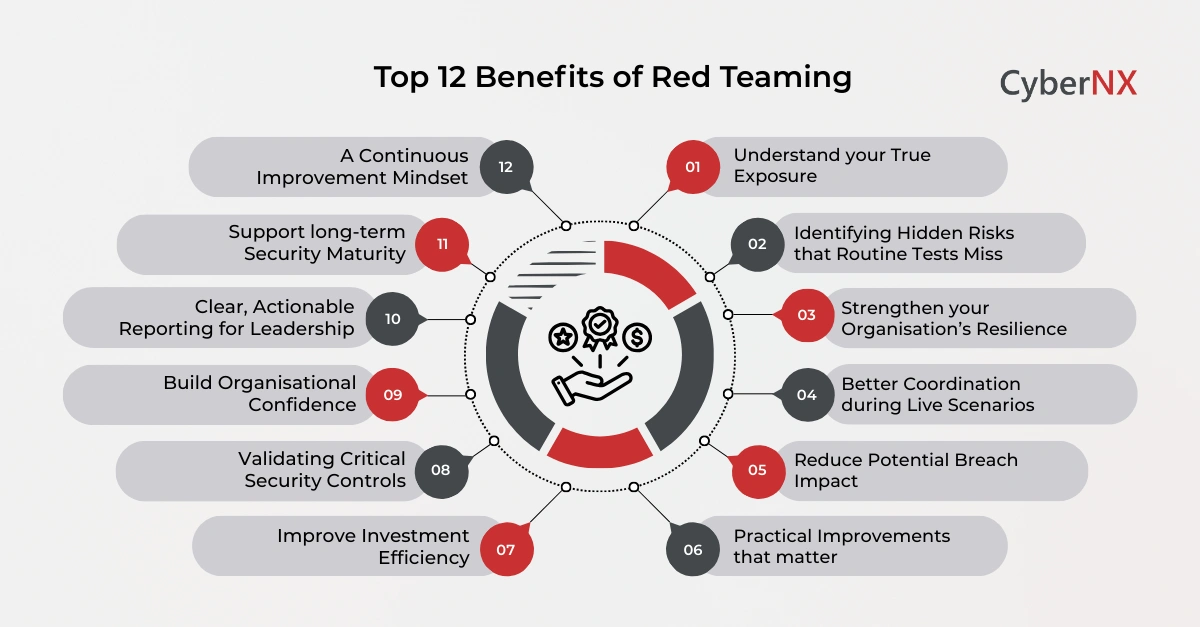
1. Understand your true exposure
Most organisations have blind spots. There are legacy systems, overlooked assets and outdated processes. Lately, there have been a surge in human errors that lead to security compromise. These areas often escape routine testing. Red teaming is highly capable of bringing them to the surface.
A red team views your environment the way an attacker does. They look for weak links and chain small gaps into a complete attack path. This gives your leadership a clear understanding of how an intrusion may unfold.
You move from assumptions to facts, see genuine attack routes and understand which controls matter most. Plus, you learn where attention must shift quickly.
2. Identifying hidden risks that routine tests miss
During engagements, we often find:
- Unmonitored endpoints
- Weak identity controls
- Misconfigured cloud assets
- Gaps in network segmentation
- Excessive privilege pathways
These may appear minor. But together, they create real exposure. Red teaming reveals these connections and shows how attackers can advance.
3. Strengthen your organisation’s resilience
Security resilience grows when teams practise under pressure. Red teaming provides that experience in a safe environment. Your SOC and IT teams experience realistic signals. They detect unusual movement, understand escalation paths and learn to respond with clarity and speed.
This hands-on experience builds resilience in a way tools alone cannot.
4. Better coordination during live scenarios
An attack forces teams to work together. Many organisations face delays because of unclear ownership. Red teaming highlights these gaps. It shows where adjustments are needed. It helps teams communicate with precision. Small operational improvements can create significant strength over time.
5. Reduce potential breach impact
Faster detection, clearer decision-making and stronger controls reduce impact. Red teaming improves all three.
This is one of the most valuable outcomes for senior leadership. You gain insight into how quickly your teams identify issues and stop them. You see where movements go unnoticed. You understand which systems need additional protection.
The result is a sharper focus on preparation, not recovery.
6. Practical improvements that matter
After a red team engagement, organisations often prioritise:
- Stronger identity protection
- Optimised EDR configurations
- Better network segmentation
- Faster escalation steps
- Clearer containment procedures
These improvements lower the impact of any future intrusion and support long-term stability.
7. Improve investment efficiency
Security budgets continue to rise. Leaders want to know where money creates the strongest risk reduction. Red teaming helps validate these decisions.
It shows which tools work. It shows which tools need tuning. It also highlights areas where investment may not deliver the expected value.
This clarity helps leaders allocate resources effectively and justify decisions to the board.
8. Validating critical security controls
Red teaming tests:
- Detection rules
- Response workflows
- Identity controls
- Cloud monitoring
- Endpoint protection
- Privilege escalation barriers
These tests confirm what is working well. They also reveal where adjustments or further investment are required.
9. Build organisational confidence
When leaders see real attack simulations, confidence grows. They understand how the organisation responds. They see progress. They make better decisions with fewer assumptions.
This confidence helps the entire security programme move forward. It also simplifies communication with executives, auditors and regulators.
10. Clear, actionable reporting for leadership
Red teaming produces findings that are easy to interpret:
- What the attacker attempted
- How they moved
- Which defences triggered
- Where gaps appeared
- What needs improvement
This clarity supports meaningful conversations at leadership level and helps teams justify strategic adjustments.
11. Support long-term security maturity
Red teaming shapes mindset. It encourages curiosity. It builds awareness. It strengthens understanding across teams.
Over time, this contributes to a stronger culture. Staff recognise unusual behaviour. Teams collaborate better. Controls evolve faster. Leaders make proactive decisions.
This cultural growth is one of the most underrated benefits of red teaming, yet it influences every corner of an organisation.
12. A continuous improvement mindset
Red teaming often becomes a cycle. Once organisations see the value, they run focused scenarios quarterly or annually. Each engagement sharpens capability. Each round improves resilience.
Continuous maturity builds defensive strength in a sustainable, measurable way.
A practical example from our work
A large financial services organisation partnered with us for a red team assessment. Their tools were modern; the team was dedicated and yet they wanted clarity.
We conducted a targeted engagement, where our team identified a single overlooked path that allowed us to move deeper into their network. The red teamer team escalated privileges quietly and reached critical systems.
This helped the leadership team understand where they needed to focus. Their teams improved detection rules, tuned monitoring and strengthened internal response. The overall security posture improved within weeks.
Conclusion
The benefits of red teaming go far beyond a technical assessment. You gain clarity on your true exposure. You strengthen resilience. You reduce breach impact. You refine investments. You build organisational confidence. And you support long-term maturity.
These outcomes help leaders plan with certainty. They help teams grow with purpose. And they help organisations build a stronger, safer future. At CyberNX, we run tailored red team engagements designed to match real attacker behaviour. Our red teaming services approach builds capability, confidence and clarity at every step. If you want a deeper view of your actual exposure, we are ready to support you.
Benefits of Red Teaming FAQs
Is red teaming suitable for organisations with emerging security capabilities?
Yes. It helps identify priority areas and gives teams practical experience that accelerates maturity.
How often should red teaming be conducted?
Most organisations prefer yearly exercises, with smaller focused scenarios across the year for continued visibility.
Does red teaming cover cloud and hybrid environments?
Absolutely. Red teams test identity, workloads, configurations and access paths across multi-cloud and hybrid setups.
Can red teaming be aligned with regulatory requirements?
Yes. Many frameworks encourage simulated attacks to validate readiness and strengthen incident response processes.